AIVideoRunbook: The Logbook That Turns Three Quality Gates Into One Pipeline
You can have three great gates and still lose track. The madebysaira safety net already existed as three separate CLIs:
- AIVideoCreditGuard checks the job before you pay — lints the prompt, estimates real cost, flags consistency and morph risk.
- AIVideoQualityGate checks the file after render — ffprobe for resolution, codec, fps, duration, audio.
- AIVideoAdherenceGate checks what the clip actually shows — motion health, morph-drift, lip-sync, creative-contract adherence.
Run them in a shell loop, sure. But then you have: which clip passed which check? which model produced it? which generation was the one that almost worked? And when a client asks "where's the version with the blue scarf," you dig through folders named after timestamps and hope.
That is the gap Runbook fills.
AIVideoRunbook
A small, offline-first CLI that turns the three gates into a single, ordered pipeline — and remembers everything.
runbook run clip.mp4 --prompt-from prompt.json→ exit0,1, or2.
CreditGuard → Runbook (orchestrate + log) → QualityGate → AdherenceGate → VERDICT + CATALOG
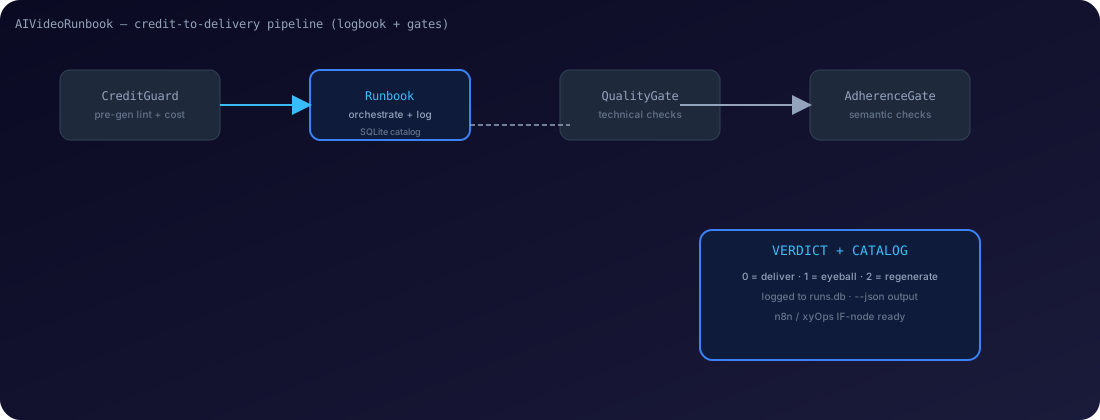
The command runs all three checks in sequence, then writes the result — provider, model, seed, prompt, cost, per-gate verdicts, and exit code — to a local SQLite catalog (runs.db). Exit 0 = deliver, 1 = eyeball, 2 = regenerate. It mirrors the exit-code contract your gates already use, so it drops straight into any IF-node.
One command, three jobs
Where the gates each answer one question, Runbook answers: "did the whole job work, and can I prove it?"
| Command | What it does |
|---|---|
runbook new |
Scaffold a prompt JSON (provider, model, seed, budget). Pass it to CreditGuard for a pre-gen lint. |
runbook run <clip> --prompt-from p.json |
Runs all gates → logs verdict + metadata → exit 0/1/2. |
runbook log --provider X --model Y ... |
Manually record a clip you rendered outside the CLI. |
runbook find "dolly" |
Search every logged run by prompt, provider, model, seed, or severity. |
runbook catalog --fmt jsonl |
Export the whole logbook as JSON lines for Sheets, scripts, or backup. |
The catalog stores the full chain: who paid (CreditGuard), what the file said (QualityGate), and what it actually showed (AdherenceGate). No cloud, no API keys, no accounts — just a SQLite file you can cp or rsync like any other asset.
Why not just shell scripts?
You can chain three if statements. Runbook does a few things the one-liners don't:
- The verdict is authoritative — it walks the gates in the right order and the worst severity wins. A
warnon QualityGate followed byokon AdherenceGate is stillwarn-overall, not silentlyok. - The log is queryable — every clip gets an
@id, a timestamp, and a--jsonrecord. No more "which generation used that prompt with the Veo hands fix?" - It is n8n-native — the
--jsonflag + exit codes let you wire the whole pipeline into a workflow.0 → deliver to client,1 → ping me,2 → regenerate. I included a ready-to-importexamples/runbook.n8n.json. - It degrades gracefully — if a gate binary isn't installed, Runbook skips it and keeps going. You get the catalog benefit immediately; install gates as you adopt them.
The three-gate stack, now connected
This is the fourth pillar, not a replacement. CreditGuard lints before you burn the credit, QualityGate checks the bytes, AdherenceGate checks the pixels — and Runbook is the logbook that remembers what happened at each step so you never have to.
The full stack now reads:
Before you pay → CreditGuard
After you render → QualityGate (technical) + AdherenceGate (semantic)
Every time → Runbook catalogs the verdict
Try it
- Repo: github.com/madebysaira/AIVideoRunbook (Python 3 + ffmpeg, zero required pip deps, 7 tests passing)
- Install:
pip install git+https://github.com/madebysaira/AIVideoRunbook.git - Quick start:
runbook new --provider Kling --model kling-vid-1.0 \ --prompt "dolly zoom hallway, slow push" --seed 42 --budget 1.50 runbook run render.mp4 --prompt-from prompt.json --json runbook find "dolly" - n8n: import
examples/runbook.n8n.json→ your gates, wired to a catalog.
Clone it, run your next clip through, and search for it by lunchtime. Three gates were never the whole safety net — the logbook is what makes the net close.", "repo": "https://github.com/madebysaira/AIVideoRunbook"
Have a project like this in mind?
I help brands and teams turn ideas into finished, living work. If something here sparked an idea, let's talk.