The Gate That Was Missing: Did Your Clip Actually Do What You Asked?
You already pay before you know if it worked. That is the whole problem with AI video in 2026.
The community math is blunt: about 1 in 3–4 generations is usable, so the real cost of a clip is 3–4× the sticker price. Veo creators put a usable 5-minute video at ~$600 after failures. The expensive part is never the idea — it is the silent, paid discovery that the clip came back wrong.
The madebysaira safety net already had two gates:
- AIVideoCreditGuard checks the job before you pay — lints the prompt, estimates real cost, flags consistency and morph risk.
- AIVideoQualityGate checks the file after render — ffprobe for resolution, codec, fps, duration, audio.
But there was a gap between those two. CreditGuard can't see the future, and QualityGate only sees bytes. Neither one answers the question that actually costs you money: did the clip do what the prompt asked, and is it physically healthy?
So I built the third gate.
AIVideoAdherenceGate
A small, offline-first CLI that runs after the render and answers one question per clip:
Did this clip actually honor the creative contract — and is it physically healthy?
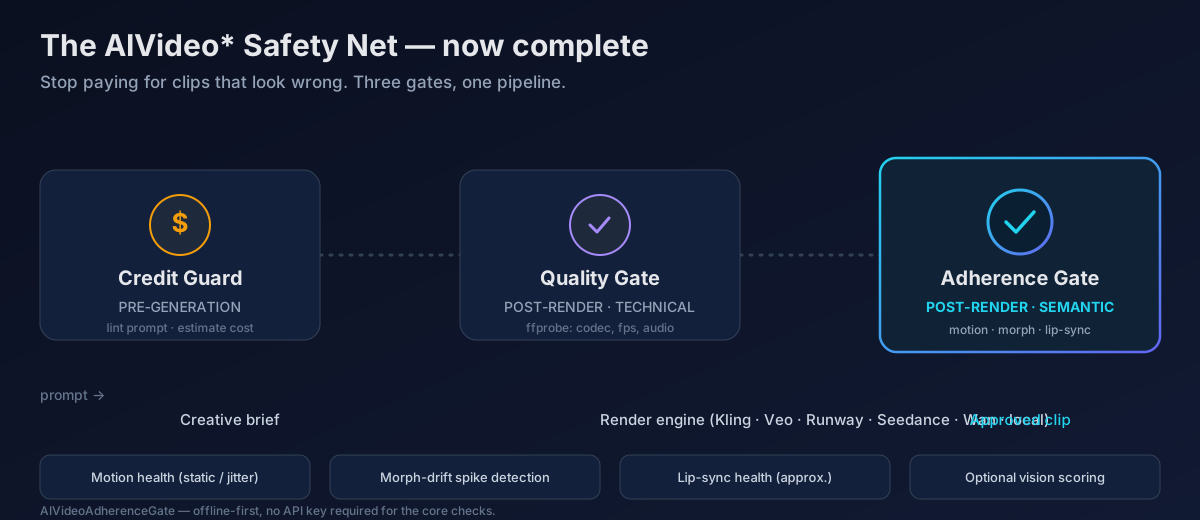
It runs five checks. The first four need no API key — just ffmpeg:
| Check | What it catches | Why it matters |
|---|---|---|
motion_health |
STATIC clips (nothing moved) and JITTER (violent frame variance) | A "cinematic close-up" that renders as a frozen frame is a burned credit |
morph_drift |
A sudden diff spike after a stable run (likely morph / identity swap mid-shot) | The #1 complaint in character work |
lipsync_health |
Audio-active windows with no corresponding mouth motion → LIKELY_DESYNC (clearly approximate) | "90% of AI music videos still look like creepy puppets" — Reddit |
technical |
Resolution, codec, fps, duration, audio stream (reuses ffprobe) | The check QualityGate already did, folded in |
vision_adherence |
(optional) Scores prompt↔clip contract via any OpenAI-compatible vision model | "Is the subject present? Did the action happen? Was the camera as specified?" |
The vision scorer is optional and off by default. Point it at OpenAI, Anthropic, or — because it speaks the OpenAI-compatible protocol — the KiosAPI router. Core checks always run offline.
Why this is the gate that was missing
The 2026 pain point is credit burn fatigue. Redditors and creators name it constantly: you queue a generation, wait, and only then see the clip is static, morphed, or desynced. By then the credit is gone.
AdherenceGate moves that discovery from after you paid and delivered to right after the render, before the retry or the client send. It is the difference between "oops, regenerate" and "oops, $40 gone."
It is also universal. It does not care which model made the clip — Kling, Veo, Runway, Seedance, Wan, Hunyuan, LTX, or a local ComfyUI stack. One checker for every output.
I audited the published plugin — and found two real bugs
Because I packaged it as an xyOps plugin for the marketplace, I owed users more than "it works on my machine." So I audited the released artifact the way a real user would install it. I built the actual published wheel, installed it into a clean venv, and ran it. It crashed:
$ ai-video-adherence-gate --help
Traceback (most recent call last):
  File ".../bin/ai-video-adherence-gate", line 5, in <module>
    from xyops_ai_video_adherence_gate.plugin import main_cli
ImportError: cannot import name 'main_cli' from 'xyops_ai_video_adherence_gate.plugin'
Two concrete, user-blocking defects:
- Broken entry point.
pyproject.tomldeclares the console script asplugin:main_cli, butmain_clionly existed in my uncommitted working tree — not in the taggedv1.0.0. The published wheel'sentry_points.txtpointed at a function that wasn't in the release. Anyone who installed it got anImportErroron first run. - Invalid marketplace launch command. The
xyops.jsoncommand wasuvx -y git+https://[email protected]. Butuvx(Astral uv 0.12) rejects the-yflag — the syntax isuvx --from <url> <script>. The marketplace "Install" button would have failed to launch.
There was also a smaller mismatch: requires-python = ">=3.8", but the code uses PEP 604 str | None annotations (Python 3.10+). So I bumped it to >=3.10.
I fixed all three, re-tagged as v1.0.1, and re-verified the published artifact end-to-end:
- Built the wheel from the
v1.0.1tag (no working-tree tricks). - Installed it into a fresh venv → console script runs cleanly.
- Ran the plugin E2E suite against the tag → 3/3 pass.
- Core engine unit tests → 10/10 pass on real ffmpeg-generated clips.
If you grabbed the plugin before the fix, just reinstall — v1.0.1 is the one that actually launches.
Using it
# single clip, human-readable report
python3 -m adherencegate.cli render.mp4

# JSON for automation, with the optional vision contract score
python3 -m adherencegate.cli render.mp4 --json \
  --prompt "a woman waving at the camera, slow dolly-in" \
  --vision-key "$OPENAI_API_KEY"
Exit codes are built for pipelines:
| Code | Meaning |
|---|---|
0 |
PASS — all checks ok |
1 |
WARN — at least one warn, no fail |
2 |
FAIL — at least one fail (or a warn with --strict) |
Drop it into an n8n workflow (see examples/n8n.json) and route on the exit code: pass → deliver, warn → eyeball, fail → regenerate before the client ever sees it.
As an xyOps plugin
uvx --from git+https://github.com/madebysaira/[email protected] ai-video-adherence-gate
It speaks the xyOps Wire Protocol (JSON over STDIN/STDOUT): live progress, a results table on the Job Details page, and a final pass/warn/fail code your workflow branches on.
The honest caveats
lipsync_healthis approximate — it compares audio activity to frame motion, not a phoneme-level aligner. It flags the obvious desyncs, not the subtle ones.- The offline motion/morph heuristics are frame-diff based on a 32px grayscale dump. They are deliberately cheap and fast, not a perceptual model.
- Vision scoring is a best-effort JSON parse of a vision model's reply.
Those caveats are the point: the gate is a cheap first line of defense, not a substitute for your eyes. It catches the 80% of failures that are obvious in hindsight and expensive in credits.
A proper landing page
The repo README is documentation, but it isn't a story. So I built a dedicated, visual landing page that explains the whole thing — what it checks, how the safety net fits together, the exit-code contract, the xyOps wiring, and a full quick-start — in the same dark editorial theme as the Hermes Agent docs. It lives on its own subdomain:
adherence-gate.madebysaira.me — the visual guide + docs for AIVideoAdherenceGate.
Try it
- Repo: github.com/madebysaira/AIVideoAdherenceGate (Python 3 + ffmpeg, no required pip deps, 10 tests passing)
- xyOps plugin: github.com/madebysaira/xyops-ai-video-adherence-gate — install
v1.0.1 - Landing page: adherence-gate.madebysaira.me
Clone it, point it at your last render, and see how many of your "good" clips were quietly wrong.
The safety net is now three gates deep. Lint before you pay, probe after you render, and — finally — check that the clip actually did the thing.
Have a project like this in mind?
I help brands and teams turn ideas into finished, living work. If something here sparked an idea, let's talk.